How Salary Confidential protects respondents' privacy
Your privacy as a survey respondent is essential to us
We recognize the trust respondents place in our platform when they join a peer survey: even when participants collectively want the benefits of a highly tailored benchmark, compensation data remains a form of sensitive information with long-standing social and professional sensitivity.
When you contribute compensation data, the person who invited you should be able to learn from it — without being able to trace it back to you. Everything in Salary Confidential is designed around that constraint.
You always know who is asking — and why
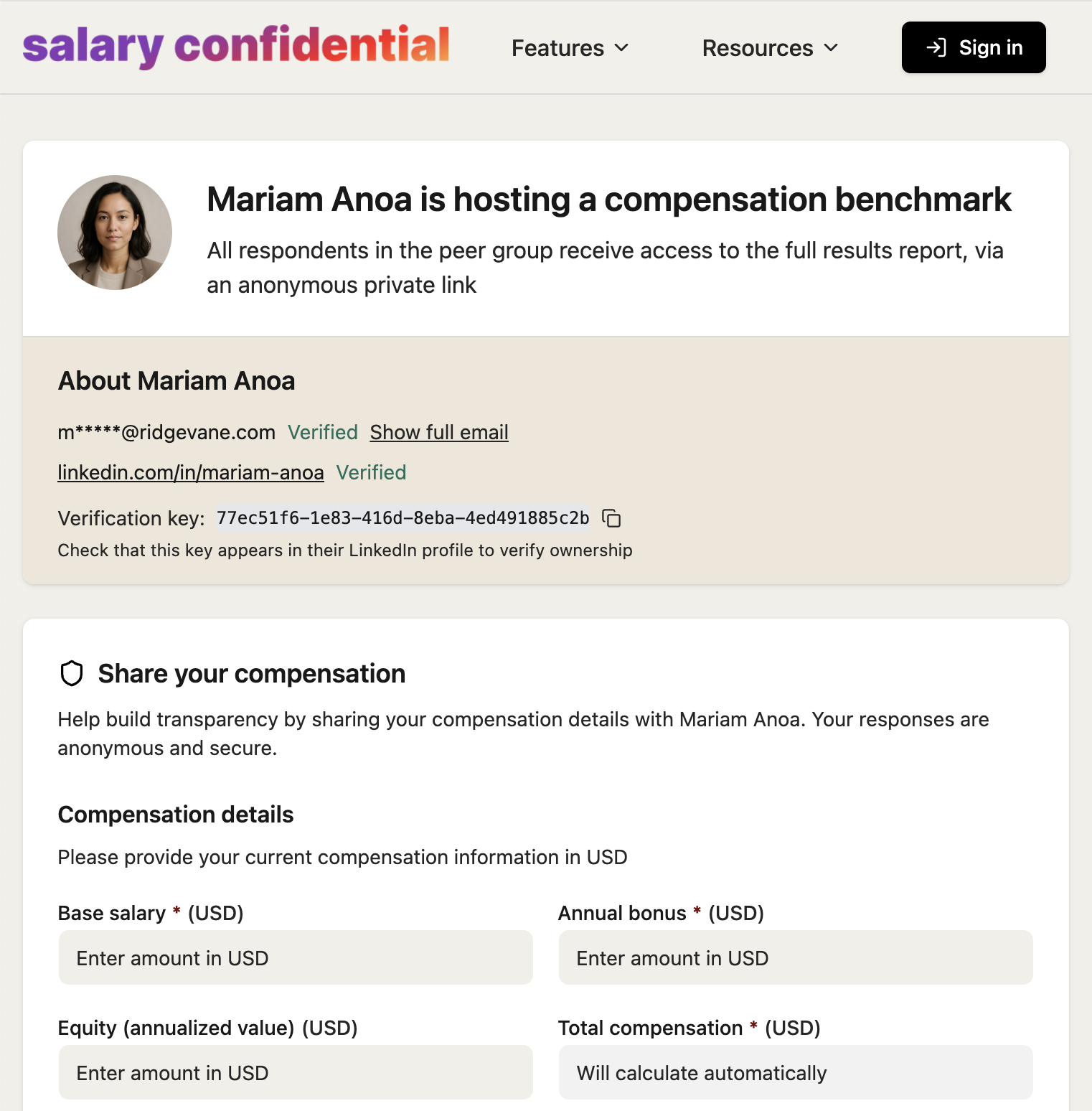
Salary Confidential does not allow anonymous requesters.
Before someone can invite peers to a survey, they must verify:
- Their LinkedIn profile, by placing a unique identifier in their bio (this profile is then locked to their account)
- Their professional email address, via confirmation email (any change requires re-verification)

Requesters cannot match people to data points
While a requester knows who they invited, they cannot determine who submitted which response.
This is enforced structurally, not by policy:
- Surveys must be created with at least four intended respondents
- Results are only released once a minimum threshold is reached
- Results are never released in batches smaller than three
- Partial or incremental release that could isolate one or two respondents is not allowed
This creates deliberate uncertainty around participation and timing, preventing a requester from reconstructing which peer contributed which data point — even in small, well-defined groups.
Partial results available
These results are released in batches of three to keep your peers anonymous. Keep sharing to unlock the next batch.
Results appear only in groups of at least three. (Read our FAQ about our batched results release).
If your survey isn't a multiple of three, the final update will include all remaining responses together.
This keeps your peers' data anonymous — always.
Individual responses (6 released of 6 collected)
Released batches: 2 of 3
Next update unlocks at 9 responses (3 more needed).
Invitations are precise — but untraceable
Survey access is controlled by single-use invitation tokens, issued by the requester to specific peers.
These cryptographic tokens guarantee that:
- only the intended peer group can respond
- no one outside that group can submit data into the survey
At the same time, the tokens are designed to be untraceable:
- the requester cannot tell whether a specific token was redeemed
- Salary Confidential itself cannot link a redeemed token to a specific response
We deliberately treat our own platform as a potential point of accidental leakage — and engineer it so that tracing data simply does not exist.
Learn more about our privacy-preserving invitation tokensWe collect as little about you as possible — and keep it isolated
We are intentional about both what we collect and where it lives:
- Respondent data is limited to what is necessary for the survey
- Operational metadata used for security or abuse prevention is never exposed in reports
- Public survey results are generated from a data surface that does not include internal audit or access metadata
- Surveys are protected against indexing, scraping, and automated collection
Even if someone were to access a survey report directly, the information required to reconstruct identity or participation is not present.
Privacy by construction, not cleanup after the fact
Rather than relying on anonymization after data collection, Salary Confidential builds privacy protections directly into:
- question design
- data structure
- result presentation
- release timing
This reduces the risk of accidental identification before results ever exist.
Why this matters
Compensation data is sensitive, and professional circles are small.
Even when names are hidden, subtle signals — timing, ordering, overly specific detail — can be enough to identify someone. Salary Confidential is designed to prevent those signals from lining up in the first place.
That's what allows respondents to contribute candidly, and in turn for all parties to learn useful, precise information — without compromising trust.
Ready to get started?
Get transformative compensation information you didn't think you could ever ask about, and make informed, confident decisions.